4 min read | 1025 words | 63 views | 0 comments
At the end of May, AT&T launched an unprecedented effort to disconnect customers by submitting applications to the Federal Communications Commission (FCC) to disconnect 184,000 residential and 15,000 business customers in California, around 60% of Pacific Bell's total customer base. While this is not a telco's first attempt to disconnect customers, it was the largest and most remarkable one to date. AT&T also sued the California Public Utilities Commission (CPUC) and the State of California for previously denying AT&T from relinquishing its status as a Carrier of Last Resort (COLR), petitioned for forbearance from its designation as an Eligible Telecommunications Carrier (ETC), through which it offers Lifeline service for low-income customers, and asked the FCC to preempt California's rules, a novel opportunity opened by the FCC's radical Network Modernization Order from the end of March 2026, which asserted FCC ability to preempt state rules that is almost certainly illegal and unconstitutional.
Consumers have not taken this lying down. Hundreds of Californians flooded the FCC dockets almost uniformly in opposition to AT&T's efforts. While a few think tanks submitted comments supporting AT&T, they were largely based on false mischaracterizations of COLR, such as the idea that it requires AT&T to provide service over copper (it does not), COLR rules stifle progress by requiring investments in particular technologies (they do not), and perpetuating AT&T's lies that everybody will be well-served (they will not be).
The CPUC asked for and partially received an extension for comments and reply comments on two of the dockets (26-123 and 26-125). While the deadlines for those dockets have now passed, the FCC has not yet taken action on these dockets. In June, The Utility Reform Network (TURN), Rural County Representatives of California (RCRC), and Communications Workers of America (CWA) sued the FCC for its lack of authority to preempt state rules; not longer afterwards, the CPUC and State of California filed their own lawsuit against the FCC. In mid-July, a judge denied AT&T's request for a preliminary injunction against the CPUC that would prevent it from enforcing its COLR rules. This means that AT&T's planned grandfathering date of July 19th in the affected discontinuance area is moot, and all Californians continue to have the right to order POTS service (not necessarily over copper, as a small minority of POTS customers are served by fiber, but the vast majority of basic voice service continues to be provided over copper).
On June 29, AT&T's applications to discontinue nearly 200,000 customers (26-120 and 26-121) were silently approved by the FCC through its inaction - under the new FCC rules, applications automatically take effect after an expedited shot clock if no action is taken to remove them from streamlined processing. This was despite massive, almost uniform opposition from the public, including the CPUC, State of California, several consumer advocacy groups, gubernatorial candidate Steve Hilton, and a coalition of almost 30 congressional representatives of California. Recently, the CPUC has filed an application for review of this docket, citing the FCC's gross failure to consider public input indicating this discontinuance would not be in the public interest. TURN, RCRC, and the CWA also submitted their own application for review. A consumer also submitted a petition for reconsideration. All three of these efforts will now force the FCC to respond explicitly to the opposition raised - no longer will it be able to hide behind its veil of silence.
In its public campaigning to misinform the public, AT&T frequently refers to costs of $1 billion in California and $6 billion nationwide to maintain its legacy copper network. These numbers sound impressive, and are designed to mislead the public into thinking that AT&T is bleeding money left and right maintaining POTS. However, AT&T's own data says otherwise. While they never publicly talk about revenue or profit from legacy services, their quarterly reports do discuss this. In Q2 2026, AT&T raked in more than $1 billion of revenue from legacy services, yielding it a profit of $523 million in just Q2. This is an annual run rate profit of more than $2 billion. While this is down from $4 billion a year ago, this still gives AT&T a 32% profit margin on legacy copper services (down from 43.6% a year ago).
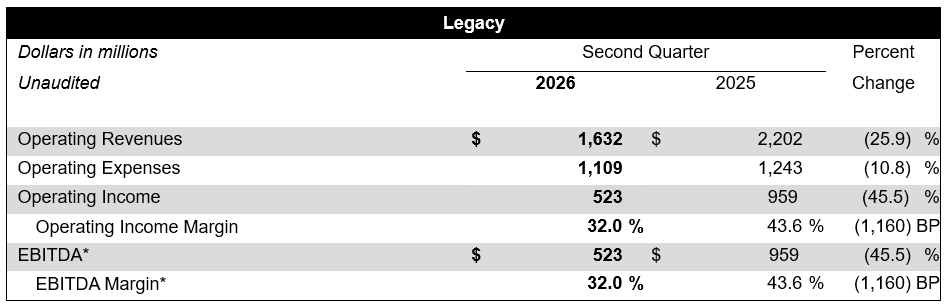
Yes, AT&T is realizing less profit as the years go by - in no small part due to its own sabotage and neglect of this segment - but the unprofitability of POTS has been greatly exaggerated. AT&T has indicated in its report it expects legacy services to become unprofitable only in 2027, after it hopes to have dropped a critical mass of customers, at which point the segment will remain unprofitable until it has retired the bulk of its legacy equipment.
In the meantime, nothing is set in stone yet. Multiple lawsuits are pending against the FCC for overstepping its authority, and AT&T's request for a preliminary injunction to grandfather has been denied. Various groups from around the country are watching this situation; other large LECs like Verizon and CenturyLink, in anticipation of a possible victory by AT&T, which would allow them to follow suit in disconnecting their own customers, and virtually everybody else, hoping the rule of law and consumer protections will prevail. Even YouTube videos have been made about these events.
While AT&T largely continues to lie to customers saying that service is grandfathered, Californian customers still have a legal right to order a landline. If you live in California, consider asserting that right! If you'd like to become further involved in the fight to preserve access to communications for ALL, not just the most profitably served, visit SaveLandlines.org or visit PhreakNet's Landline Action Bulletin.
If you live in California and have been illegally denied a landline by AT&T, immediately escalate to the AT&T President's Office at 1-800-355-9542 and file a complaint with the CPUC Consumer Affairs Branch at 1-800-649-7570. You can also reach out to the Coalition to Save Landlines for personal assistance at (510) 777-6622.
Log in to leave a comment!